These ideas rest on a few working principles about keys, scales, and the chromatic scale. This essay lays them out, then tests how chords function once all twelve tones are admitted into a key.
My Evolving Chromatic Pitch Theory
My basic view of tonality (harmony) is as follows:
- Keys and scales are not the same thing. We have major, minor, and a variety of other scales or modes, and we have twelve distinct key centers that can be established in a number of ways.
- The chromatic scale is the mother mode.
- Diatonic scales/modes are secondary.
- Any key can also be analyzed from a different key center, and the same is true for scales and chords. (C Ionian, for example, can be reinterpreted as D Dorian, or even viewed as a yet-tobe-named scale on an Eb tonic.)
- We have modes and altered modes.
- In our fully chromatic world, however, C Ionian can be viewed this way: 1, 2, 3, 4, 5, 6, 7, and 8 are the primary scale tones; b2, b3, #4, b6, and b7 are secondary scale tones; 1, 3, and 5 are the primary tertian chord tones; 7, 9, 11 (which deserves special attention because it lies a half step above the 3), and 13 are upper extensions; and 15, 17, 19, 21, and 23 are hyperextensions or superextensions.
- All tempered twelve tones exist as sound in a realm where all sound is music.
Pat Metheny was asked by a student, “How do you play outside of a chord?” His answer: “I can hear any tone on any chord as belonging to that chord.” The implication is that all twelve tones can exist within the harmonic structure of any chord quality.
Further, if you accept Schoenberg’s idea of chromatic keys, any chord can exist within the framework of any tonal center.
These approaches open up a huge space for deriving tonal music from the chromatic scale. We are free to harmonize any note with any chord and to conceive of any chord as belonging to any key.
Chromatic Tonality
Chord function, with regard to these chromatic keys, is tricky. We have twelve notes that we can use as a root to build any of the previously mentioned chords. Understanding how we hear chords is integral to a discussion of chord development using 12-tone scales.
As we build increasingly complex chords, such as sevenths, ninths, and elevenths, our concept of how a pitch functions within a scale changes along with the new interval relationships. The 7 was once thought of as dominant; it no longer is. Now the complete structure of the chord determines how we hear it within the key and in relation to chromatic twelve-tone tonality.
As the fourth note of stacked thirds on the I chord, the 7 is tonic; as the third of a V chord, it is dominant. Even a #9 or #5 can be part of a tonic I chord.
Levine (1995, p. 286) provided an illustration of such: If the I7 can be thought of as tonic functioning, perhaps other dominant chords, such as the VI7 can be also.
If there is something comparable to function in twelve-tone chord harmony, since every chord contains every pitch, the function of a particular chord will not be determined by which pitches are included in the chord, but rather by how those pitches are ordered. In triadic harmony, a V triad is dominant, as it contains the pitches 5, 7, and 2, which want to resolve to the tonic. In seventh chords, this same structure is part of the Imaj7 tonic chord, i.e., 1, 3, 5, 7. It was once common for theorists of the classical tradition to consider the 7 to be a non-chord tone, which needed to be resolved. In other words, the 7 could not be a part of the I-tonic chord. Consider function with respect to “dyadic harmony.” Within a 9, 11, or 13 chord we may see an extension of this same principle. As the V-triad has become the upper structure of Imaj7, so might the V7 chord become an upper structure of some kind of I-chord.
We hear chords in two ways: (1) by virtue of their internal intervallic structures, and (2) by virtue of their relationships to the tonal center in which they exist, or tonal centers in a theoretical polytonal setting. A major triad is heard as such because it contains a major third and a perfect fifth within itself. A V chord, e.g., G in the key of C, is heard as dominant because it contains the tone B, which resolves to C. This structure affects the way we perceive chords. Two identically structured chords can have a different function depending on their position within a key. For instance, even though they have the same vertical structure, Cmaj7 functions as a tonic while Fmaj7 functions as a subdominant.
Chords borrowed from parallel modes offer options for harmonic movement that have been accepted as part of functional harmony. For example, the bII/IV (the IV refers to the bass-tone only), the so-called Neapolitan chord, and the II-7b5 have both been clearly recognized as having subdominant function. The Neapolitan chord is borrowed from the Phrygian and the II-7b5 is borrowed from the minor.
There is a precedent to analyzing chords borrowed from parallel modes in terms of function. The II-7b5 is commonly considered to be subdominant minor, and thus has been commonly employed. It enables the use of the b6. Also, the Neapolitan chord borrowed from the Phrygian mode and scale is considered to be subdominant, even though it introduced a chromatic note, the b2.
How do all of the chromatic chords derive from modal borrowing function?
One method I’ve come up with follows:
Any dominant 7 chord that resolves to any tonic functioning chord will be considered dominant functioning. G7 and Db7, resolve to C (although Db7 considered in the below chart); F7 and B7, resolve to Em7; E7 and Bb7 resolve to Am7. These also include -7b5 chords built off of the thirds of any of the dominant functioning chords
All chords that the previously mentioned Dominant 7th chord resolve to will be considered tonic functioning: Cmaj, Cm7, Ebm, Ebmaj7, Em7, Emaj7, Am7, Amaj7, Gbmaj7, Gbm7.
Subdominant functioning chords will be identified by their ability to act as pre dominant:

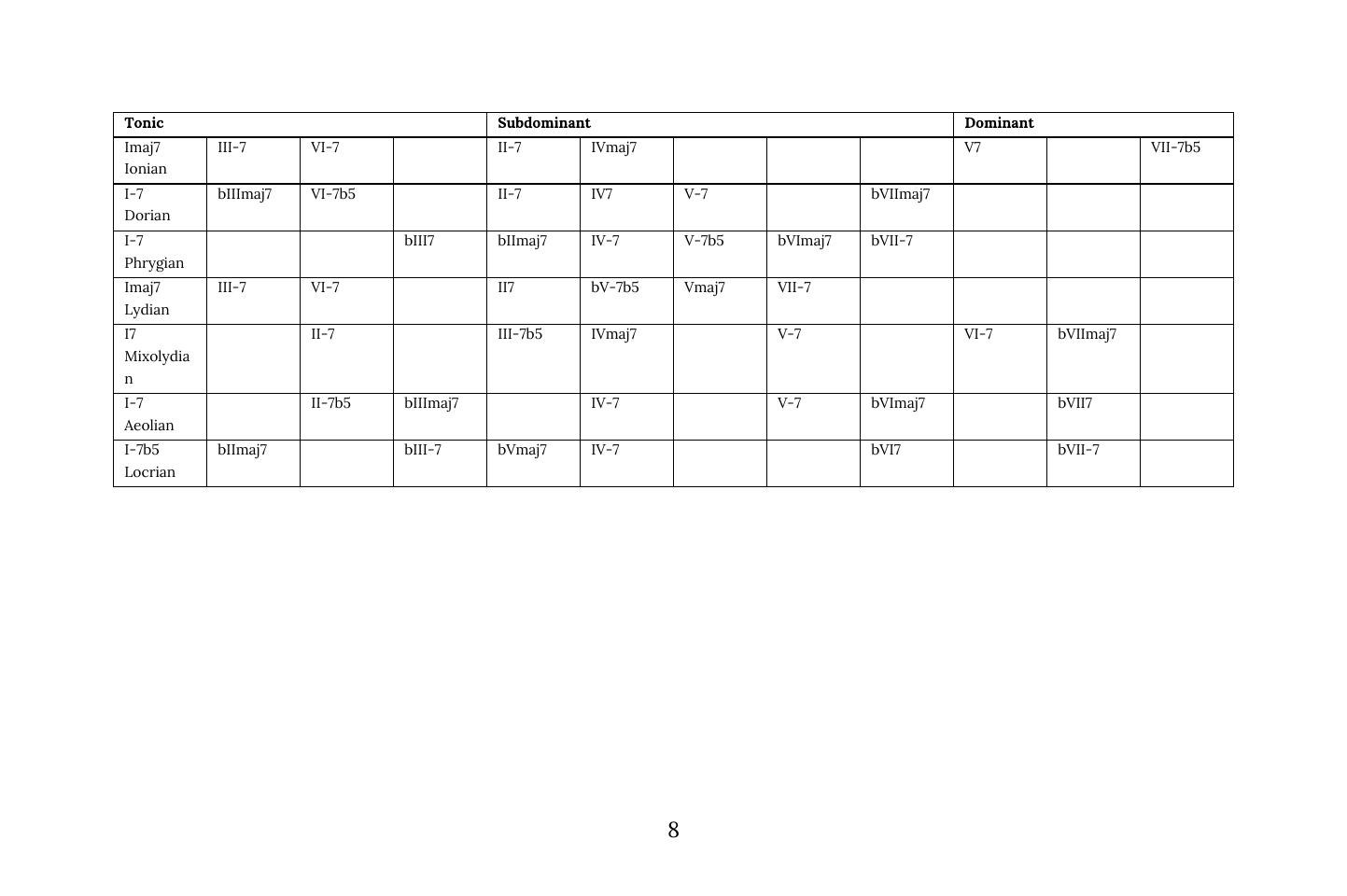
It gets more complicated still when we consider the Imaj7#5.
Mark Levine (1995) theorized that it is a tonic function. If this is true, we have a situation where the b6 does not resolve to 5 and is considered to be a member of a stable I chord. The bVImaj presents another issue, because it contains the chromatic pitch b6 in the key. Like the 4’s needing to resolve to 3, the b6 may also want to resolve to 5. There is some evidence that chords with the b6 from the key may be considered subdominant. Compare the Imaj7#5 to the bVI maj7, which both contain the 1 as a chord tone.
Their internal structure and notes in relationship to the tonic may determine their function. The bVI has a b3, the Imaj7#5 has a 3; the bVI has the 5, the Imaj7#5 does not have the 5; the Imaj7#5 has a 7, the bVI does not. Perhaps the bVImaj7 may indeed be considered tonic functioning or subdominant functioning, because it contains the 5 and b6.
When testing the function of chromatic chords, I test these chords with my ear. I like to play II-V-I’s a few times in order to firmly set the tonal center in my ear. I substitute the chord in question for the II, V, or I, and decide where I like it the best. If at any time I start to lose the sense of key, I reset the key by playing simple II-V-I’s. It may be necessary to use inversions so as not to get confused about good voice leading and a chromatic chord’s ability to sit in a key. I discovered this when I was experimenting with the bVmaj7. Depending on where I used it, inversions became a valuable asset. Recognizing that a lot of these are tonal, there should be no doubt that these chords can exist in any key. To hear how it sounds, set the tonic by cadence and then interject one of these chords in the progression.
In strict diatonicism we have clear and obvious guidelines for determining function. Chords with 4 but not 7 are subdominant, chords with 4 and 7 are dominant, and the others are tonic. It’s worth mentioning that these rules apply to the primary chord structure, in what might be considered the first octave. In other words: In the first four notes of the chord, the 1, 3, 5, and 7, we do not consider these rules to apply to the extensions of the chord.
For example, in the key of C, although Fmaj7#11 contains both a 4 and a 7 in the key of C, it is still considered subdominant functioning. The 7(B) is an extension and not part of the chord’s primary structure.
Determining function in a full chromatic environment is a bit tricky and might not even be appropriate. We might have to revise our notions of function in light of all of these possibilities. I consider chords that are pre-dominant to be subdominant, through principles of voice leading. So I might consider D7 to be subdominant in the key of C because it moves to G7 very well. The D7 contains the 1 and the #4 in the key of C. I also would consider the Abm7 to be subdominant function. It contains the note #4 and 7 in the key of C. Perhaps an amendment to the concept of chromatic chord function would include chords that either contained the 4 and not the 7, or the #4. It gets ambiguous, because if we accept that, we would then say that Gbmaj7 is subdominant functioning in the key of C because it contains the #4 and 7. Perhaps it is, but it also works really well as a tonic functioning chord in the key of C. Function becomes very complicated in light of a concept of chromatic keys.
Looking at chromatic chords through these varying concepts, in the key of C, a D7 might be seen as being borrowed from C Lydian, or it could be viewed as a product of a C Ionian scale (raising the F to F#). In the latter case we derive the same note we’d get from the modal borrowing principle. If the D7 moves to G7, we see parallel motion in action. In addition, we see the beginning of a symmetrical movement involving the division of several five octaves into 12 equal parts (perfect fourths): D7-G7-C7-F7-Bb7- Eb7-Ab7-Db7-Gb7-B7-E7-A7-D7.
Twelve tone technique and serialism (partial twelve tone technique, as there may be no need to destroy tonality) can be integrated into music via these principles: (1) Any chord can have all twelve tones, and (2) Any key can have any chord.
The basic premise of jazz theory regarding chromatic tonality is that a tonal center is established by the presence of the I and V chords and either the IV or ii chord in progression. This center remains in our ears, such that we hear all chords against the primary pitch, or tonic. As long as a new key is not set, any chords can be played using any of the notes of the chromatic scale, and we hear these chords in relation to the tonic.
When we distinguish between scale and key, chromatic chords can, and do, function within the context of a tonal center, and any chord can exist within any key. In the key of C there are 12 notes that can be played in a chromatic, or half-step, pattern. In ascending order they are C, Db, D, Eb, E, F, Gb, G, Ab, A, Bb, and B.
We don’t count the C at the top as part of the series, because it begins a new chromatic scale an octave higher. Do we relate these 12 notes to the key center according to their position in the scale, as tonic, subdominant (or predominant), dominant, and so on?
How do these chords function in the key of C? I make a clear distinction between key or tonal center and scale. The key can be set in a number of ways or cadences, some of which are not diatonic. For example, in the progression, Abm7 -Db7 -Cmaj7, Ab- 7 and Db7 don’t belong to C major. However, they still establish C as the tonal center and so perhaps Ab-7 might be considered subdominant or pre-dominant in the key of C. Consider all of the chords from Gb major to understand how they function in C.
Some of them can also be accessed through modal borrowing.
Working to develop chord structures within a relative chromatic harmonic structure may appear confusing. To describe it appropriately, I’m struggling to adapt my thinking to accept all the possibilities available within the framework of chromatic chord function. Do these chords all fit within the tonic, subdominant, or dominant tonal function? Can we fit so-called secondary dominants and their related II’s, tri-subs, and related II’s into this idea of function? Can we fit borrowed chords into this idea of functional harmony? Czech musicologist and semiotician Jaroslav Volek (1968) developed a theory attempting to add chromatic mediants as a fourth basic function in traditional harmony structures. Volek’s view might allow us to more easily categorize other chromatic chords. Do we need this fourth function, or does the common-tone tonality do a better job of analyzing these relationships? How does multi-tonic symmetrical harmony fit in?
How does the use of parallel harmony fit in? The framework of a chromatic tonality is not easily understood, but it’s absolutely necessary for us to consider it if we wish to move forward.
Another important distinction is between scale degree and function. Calling a note “tonic” doesn’t necessarily identify it as the first note in the scale or I chord. Rather, the word refers to how the chords and notes function in the key. Functionally, tonic refers to the I-chord or any of its substitutes that share its chord tones, including III-7 and VI-7. The II-7 and IVmaj7 are subdominant functioning, whereas I consider V7 and VII-7b5 to be dominant functioning. I consider the primary subdominant chord to be II-7, even though subdominant may literally refer to the fourth degree of the scale.
Consider a series of two consecutive Major 7 intervals that create two consecutive half-steps or two consecutive Major 7 intervals in one chord, like a C chord that has a B and a Bb. These voicings allow for both the major 7 and flat 7 to exist simultaneously. The three consecutive half steps occur between Bb, B, and C per the example below of a chord played by Herbie Hancock.
You can see that there is an Eb, E, and an F. In this case, Hancock has constructed the chord with the F in the bass, the E a 7th above the F, and the Eb a 7th above the E. Remember that major sevenths are considered to be more consonant than their inverse b2s. This is what enables us to put a 10th on top of a sus7 chord.
Does it sound weird? Yes! But so does a maj7#9 chord the first time you hear it.